Within installed infrastructure
The infrastructure is fixed. The operating strategy is not.
For an existing utility-scale PV plant, the question is how to operate within the layout and equipment already in place. AridMetrics investigates tracker strategies and constrained adjustments without treating installed geometry as a control variable.
Tracker-strategy research; not a production-ready controller
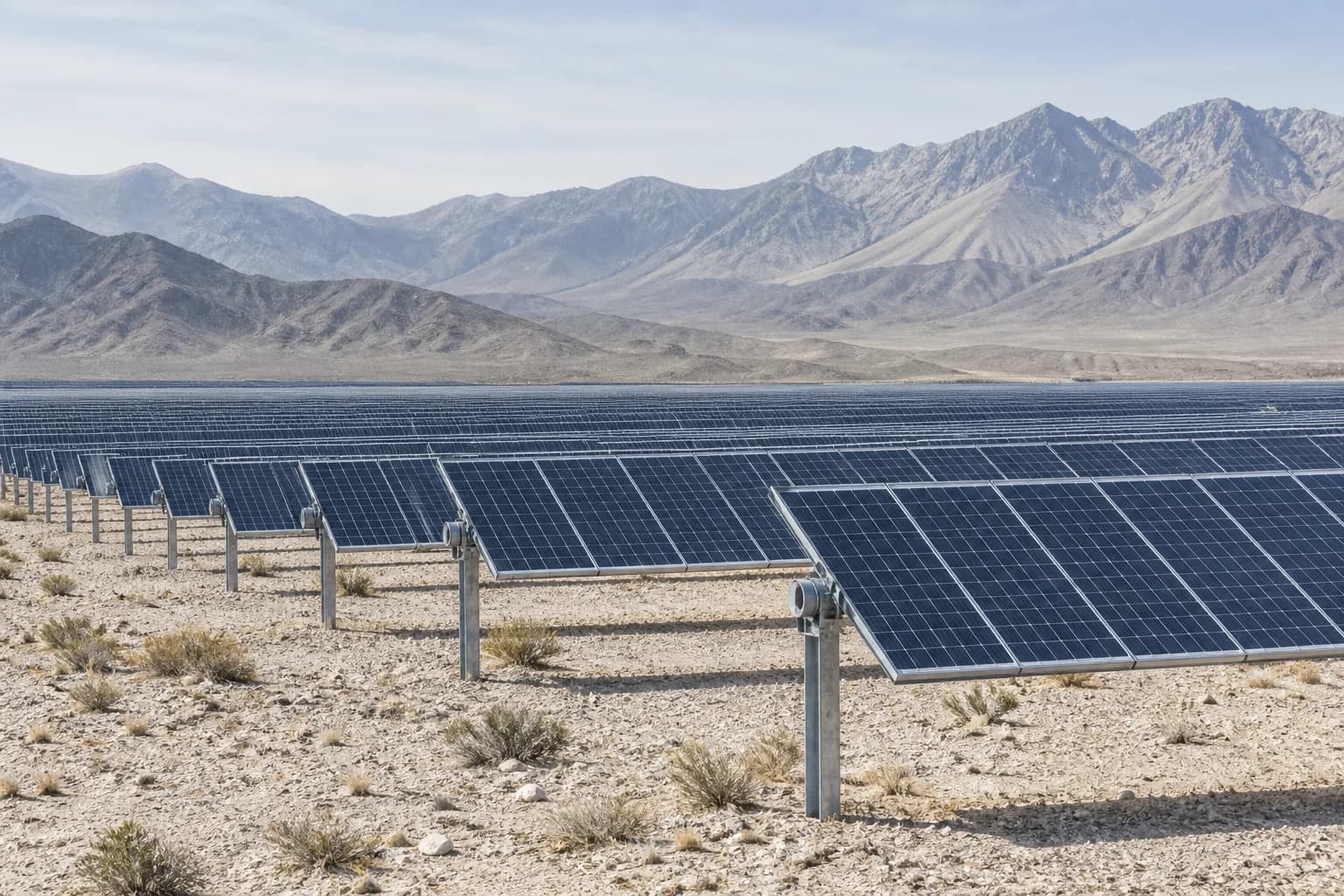
What stays fixed
Begin with the plant that actually exists.
An operational comparison should share one installed configuration. Changing the infrastructure would change the question being asked. Record the geometry and hardware limits first, then hold them constant while examining possible tracker strategies.
- Pitch and GCR
- Installed row geometry
- Land footprint
- Installed equipment limits
What may change
Operating variables & constraints
Possible operating variables concern how the trackers move, not where the plant is built. The available choices depend on the equipment and the applicable operating rules.
Permitted motion depends on installed equipment and control limits.
- 01Tracker angle
- Examine permitted orientations at a given time.
- 02Backtracking and offsets
- Compare defined departures from a documented reference strategy.
- 03Operating strategy
- Specify when an adjustment is considered and why.
- 04Control constraints
- Keep motion limits, safety requirements and other applicable restrictions explicit.
A clear comparison basis
Reference tracking, plus a constrained adjustment.
A reference strategy establishes the tracker position against which an alternative is examined. It may include standard tracking and backtracking appropriate to the plant geometry. An alternative then changes only the specified operating decision, subject to the same installed constraints.
Conceptually, tracker position combines reference tracking with a constrained adjustment. Comparisons share weather inputs, geometry, model assumptions and the evaluation period.
An illustrative position relationship, not a claim of better performance.
Orientation and neighbouring rows
Backtracking balances direct reception and row shading.
A sun-facing tracker orientation can cast shade onto another row when the sun is low. Backtracking rotates the collectors away from that orientation to manage this geometric shading. The response depends on the solar position, row relationship and tracker limits.
Avoiding direct shade and receiving the most direct light are therefore not identical objectives at each instant. Sky diffuse and ground-reflected light also contribute to plane-of-array irradiance. Evaluating a strategy requires accounting for each contribution.
Illustrative cross-sections. Direct-shade avoidance alone does not establish an energy advantage.
Research direction
Condition-aware operation requires evidence first.
Research includes condition-aware tracker strategies within equipment and energy constraints. Climate and weather describe the operating context, not effects the controller can produce.
Proposed strategies require measured-data evaluation and explicit uncertainty before a performance claim. Safe equipment limits remain requirements.